In-House vs Outsourced EDI: The True Cost, Risk, and ROI
By Brian Eckenrod on
In-House vs Outsourced EDI: The True Cost, Risk, and ROI
For mid-market manufacturers and distributors, EDI decisions are no longer just an IT preference—they’re a performance and risk decision. Comparing in-house vs outsourced EDI based on software cost alone misses the real drivers: staffing coverage, partner onboarding speed, exception handling, and the cost of failures.
This guide breaks down the full cost model, highlights where hidden risk accumulates, and provides a practical framework to decide which operating model fits your organization.
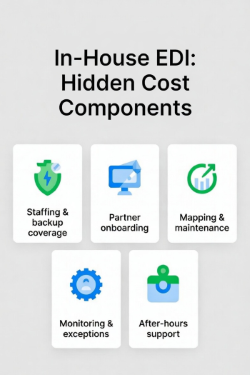
1) What “In-House EDI” Actually Includes
In-house EDI is not a tool—it’s an ongoing operational capability. Beyond licenses, you are responsible for the work that keeps transactions flowing and trading partners satisfied.
- Partner onboarding: testing, certification, timelines, and go-lives
- Mapping maintenance: partner-specific variants and change requests
- Standards and compliance: X12/EDIFACT updates, industry requirements
- Monitoring and exceptions: missing docs, rejects, and downstream ERP errors
- After-hours coverage: outages and urgent partner escalations
If these responsibilities are spread across multiple roles, the cost may be hidden—but it is still real and grows with complexity.
2) The Hidden Cost Drivers Most Teams Miss
When EDI runs internally, costs tend to show up as “noise” rather than line items. The most common hidden drivers are:
- Key-person dependency: one analyst becomes the single point of failure
- Delay costs: slow onboarding delays revenue, orders, and partner performance scores
- Chargebacks and penalties: missed ASNs, late invoices, and compliance issues
- Change-request drag: every partner change becomes a mini-project
These costs are why internal EDI may look “cheaper” on paper while becoming more expensive in practice.
3) How Outsourced EDI Changes the Operating Model
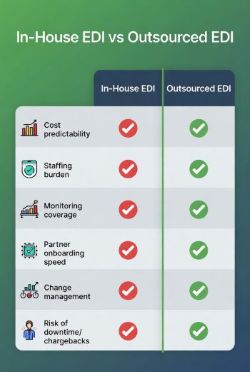
With a managed EDI provider, you’re not buying software—you’re outsourcing operations. That typically includes:
- Dedicated onboarding and trading partner coordination
- Ongoing mapping and standards maintenance
- 24/7 monitoring and exception management
- Defined response/resolution SLAs and escalation paths
- Integration support for ERP upgrades and changes
The benefit is predictability: costs and responsibilities are clearly defined, and scaling no longer requires incremental internal headcount.
Managed providers also support integration updates during ERP upgrades and system changes. Learn more about our ERP integration partnerships and how they simplify EDI operations.
4) When In-House Still Makes Sense
In-house EDI can be the right fit when all of the following are true:
- Low partner count and low change frequency
- Stable ERP environment with few upgrades or integrations
- Redundant internal EDI expertise (not one person)
- Limited need for after-hours coverage
If your environment is growing or partner requirements change often, internal EDI tends to become fragile over time.
5) A Practical Decision Framework for Manufacturing & Distribution
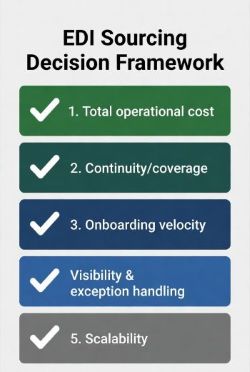
When evaluating in-house vs outsourced EDI, score each option using criteria leaders care about:
- Total operational cost: people + tooling + support overhead
- Continuity: coverage during vacations, turnover, and incidents
- Onboarding velocity: how fast you can add new partners
- Visibility: real-time status, alerts, and exception workflow
- Scalability: growth without breaking processes or adding headcount
If you’re actively evaluating providers, use this as a baseline and add your unique partner requirements and ERP constraints.
Conclusion
The true cost of EDI is rarely captured by license fees or transaction pricing. It shows up in delays, exceptions, chargebacks, staffing risk, and the effort required to scale.
Next step: Talk with our team to review your partner landscape and determine whether managed EDI is the right operating model for your organization.
Comments are closed