Author Archives: Brian Eckenrod

  1. In-House vs Outsourced EDI: The True Cost, Risk, and ROI

    Leave a Comment

    In-House vs Outsourced EDI: The True Cost, Risk, and ROI

    For mid-market manufacturers and distributors, EDI decisions are no longer just an IT preference—they’re a performance and risk decision. Comparing in-house vs outsourced EDI based on software cost alone misses the real drivers: staffing coverage, partner onboarding speed, exception handling, and the cost of failures.

    This guide breaks down the full cost model, highlights where hidden risk accumulates, and provides a practical framework to decide which operating model fits your organization.

    1) What “In-House EDI” Actually Includes

    In-house EDI is not a tool—it’s an ongoing operational capability. Beyond licenses, you are responsible for the work that keeps transactions flowing and trading partners satisfied.

    • Partner onboarding: testing, certification, timelines, and go-lives
    • Mapping maintenance: partner-specific variants and change requests
    • Standards and compliance: X12/EDIFACT updates, industry requirements
    • Monitoring and exceptions: missing docs, rejects, and downstream ERP errors
    • After-hours coverage: outages and urgent partner escalations

    If these responsibilities are spread across multiple roles, the cost may be hidden—but it is still real and grows with complexity.
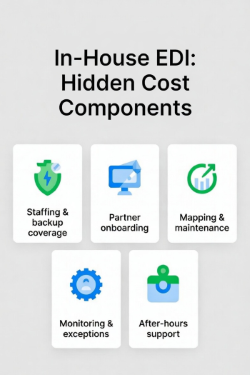
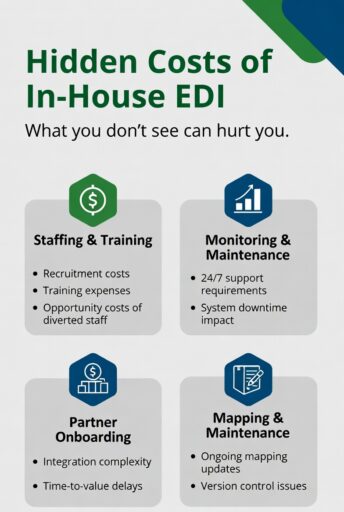
    Hidden cost components of in-house EDI operations
    In-house EDI costs are mostly operational—not software.

    2) The Hidden Cost Drivers Most Teams Miss

    When EDI runs internally, costs tend to show up as “noise” rather than line items. The most common hidden drivers are:

    • Key-person dependency: one analyst becomes the single point of failure
    • Delay costs: slow onboarding delays revenue, orders, and partner performance scores
    • Chargebacks and penalties: missed ASNs, late invoices, and compliance issues
    • Change-request drag: every partner change becomes a mini-project

    These costs are why internal EDI may look “cheaper” on paper while becoming more expensive in practice.

    3) How Outsourced EDI Changes the Operating Model

    With a managed EDI provider, you’re not buying software—you’re outsourcing operations. That typically includes:

    • Dedicated onboarding and trading partner coordination
    • Ongoing mapping and standards maintenance
    • 24/7 monitoring and exception management
    • Defined response/resolution SLAs and escalation paths
    • Integration support for ERP upgrades and changes

    The benefit is predictability: costs and responsibilities are clearly defined, and scaling no longer requires incremental internal headcount.

    Managed providers also support integration updates during ERP upgrades and system changes. Learn more about our ERP integration partnerships and how they simplify EDI operations.
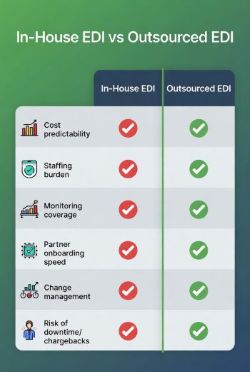
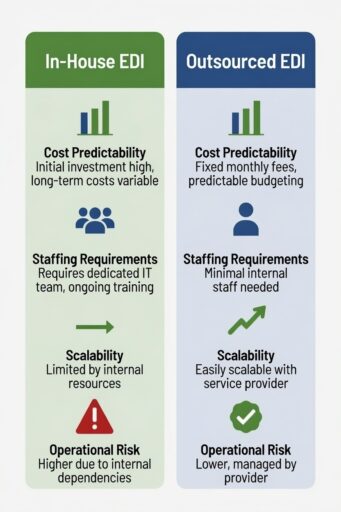
    Comparison of in-house EDI versus outsourced EDI cost and risk
    Managed EDI replaces hidden operational risk with defined coverage.

    4) When In-House Still Makes Sense

    In-house EDI can be the right fit when all of the following are true:

    • Low partner count and low change frequency
    • Stable ERP environment with few upgrades or integrations
    • Redundant internal EDI expertise (not one person)
    • Limited need for after-hours coverage

    If your environment is growing or partner requirements change often, internal EDI tends to become fragile over time.

    5) A Practical Decision Framework for Manufacturing & Distribution

    When evaluating in-house vs outsourced EDI, score each option using criteria leaders care about:

    • Total operational cost: people + tooling + support overhead
    • Continuity: coverage during vacations, turnover, and incidents
    • Onboarding velocity: how fast you can add new partners
    • Visibility: real-time status, alerts, and exception workflow
    • Scalability: growth without breaking processes or adding headcount

    If you’re actively evaluating providers, use this as a baseline and add your unique partner requirements and ERP constraints.
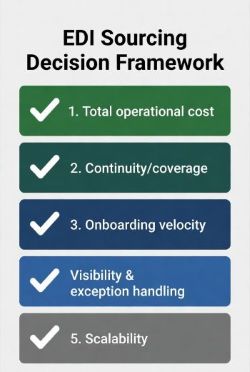
    Decision framework checklist for choosing in-house versus outsourced EDI
    Decide using cost, risk, visibility, and scalability.

    Conclusion

    The true cost of EDI is rarely captured by license fees or transaction pricing. It shows up in delays, exceptions, chargebacks, staffing risk, and the effort required to scale.

    Next step: Talk with our team to review your partner landscape and determine whether managed EDI is the right operating model for your organization.
  2. The True Cost of In-House EDI vs. Outsourced EDI

    Leave a Comment

    The True Cost of In-House EDI vs. Outsourced

    Many manufacturers and distributors evaluate EDI decisions based on software licensing or transaction fees alone. In reality, the true cost of EDI—whether managed internally or outsourced—extends far beyond tooling.

    Understanding the full operational, financial, and risk implications of each model is critical before committing to a long-term approach.

    1) What “In-House EDI” Really Includes

    Running EDI internally is not just about owning software. It requires sustained operational capability.

    • Dedicated EDI analysts and backup coverage
    • Ongoing partner onboarding and certification work
    • Standards maintenance and mapping changes
    • 24/7 monitoring and exception handling
    • Dependency on key individuals and tribal knowledge

    These costs are often distributed across teams and budgets, making them easy to underestimate.

    2) The Risk Profile of In-House EDI

    Beyond cost, internal EDI introduces operational risk.

    • Single points of failure when key staff leave
    • Delayed partner onboarding during peak periods
    • After-hours incidents without coverage
    • Limited visibility into transaction-level issues

    These risks often surface during growth, ERP upgrades, or supply chain disruptions—exactly when EDI stability matters most.

    Hidden cost components of in-house EDI operations
    In-house EDI costs extend well beyond software licensing.

    3) How Outsourced EDI Changes the Cost Structure

    Managed EDI shifts EDI from a fixed internal cost to a predictable operating model.

    • Dedicated onboarding and support teams
    • Defined SLAs and escalation paths
    • 24/7 monitoring and proactive issue resolution
    • Scalability without incremental headcount

    While outsourced EDI includes vendor fees, it often reduces total cost when labor, risk, and delays are factored in.

    4) When In-House EDI May Still Make Sense

    In-house EDI can be viable when:

    • EDI volume and partner complexity are very low
    • There is deep internal EDI expertise with redundancy
    • Growth and partner changes are minimal

    However, as complexity increases, these conditions become harder to maintain.

    Comparison of in-house EDI costs versus outsourced EDI costs
    Outsourced EDI replaces hidden costs with predictable pricing.

    5) A Practical Decision Framework

    When deciding between in-house and outsourced EDI, evaluate:

    • Total operational cost (not just software)
    • Staffing risk and continuity
    • Partner onboarding velocity
    • Monitoring and issue resolution maturity
    • Ability to scale without disruption

    The right choice is the one that supports growth without increasing fragility.

    Conclusion

    The true cost of EDI is rarely visible on a balance sheet. It shows up in delays, errors, staffing challenges, and missed opportunities.

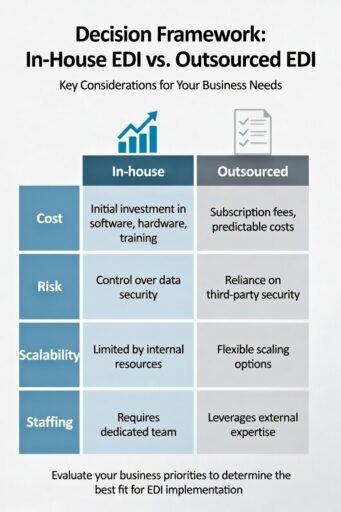
    Decision framework for choosing in-house versus outsourced EDI
    EDI decisions should be evaluated through a cost, risk, and scalability lens.

    Next step: Talk with our team to evaluate whether in-house or outsourced EDI is the right operating model for your organization.

  3. How to Choose the Right EDI Outsourcing Partner: A Practical Buyer’s Guide

    Leave a Comment

    How to Choose the Right EDI Outsourcing Partner: A Practical Buyer’s Guide

    Outsourcing EDI is no longer just an IT decision—it’s an operational and financial one. The right EDI outsourcing partner can reduce errors, accelerate partner onboarding, and eliminate key-person risk. The wrong one can create hidden costs, integration gaps, and long-term lock-in.

    This guide walks through how manufacturing and distribution leaders should evaluate managed EDI providers—what to look for, what to avoid, and how to make a decision that scales.

    1) Start With Your Trading Partner Reality

    Before evaluating vendors, document your real environment—not the simplified version.

    • Number of active trading partners
    • Top partners by transaction volume and revenue impact
    • Standards in use (ANSI X12, EDIFACT, GS1 variants)
    • Protocols required (AS2, SFTP, FTPS, VAN)
    • Document types (850, 856, 810, 997, etc.)

    A qualified managed EDI provider should ask for this information early and use it to define scope and onboarding sequencing.

    Trading partner complexity map for EDI outsourcing evaluation

    Your real partner mix defines the scope—not the vendor’s brochure.

    2) Evaluate Operational Coverage, Not Just Software

    Many providers sell tooling first and operations second. Managed EDI should be the opposite.

    Ask specifically who handles:

    • Partner onboarding and certification
    • Mapping changes and partner-specific variants
    • Exception monitoring and resolution
    • Standards updates and compliance changes
    • After-hours failures and urgent escalations

    If responsibilities are vague, risk will fall back on your internal team.

    3) Demand Clear SLAs and Monitoring Visibility

    EDI failures don’t show up as obvious outages—they surface as missing ASNs, delayed invoices, or partner complaints.

    A strong provider offers:

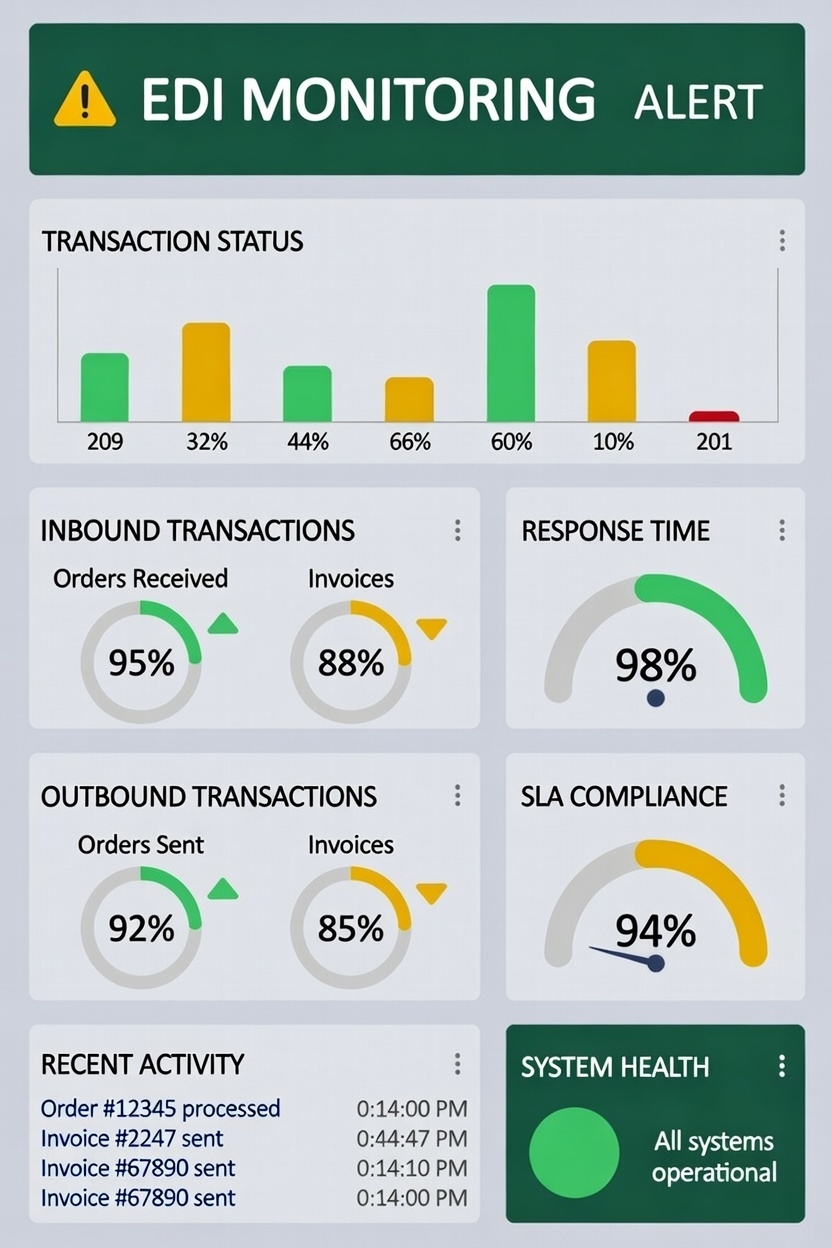
    • 24/7 monitoring with proactive alerts
    • Defined response and resolution SLAs
    • Clear escalation paths
    • Visibility into transaction status and exceptions
    Managed EDI monitoring dashboard and SLA visibility

    Visibility and accountability matter more than raw throughput.

    4) Understand the True Cost Model

    EDI outsourcing pricing varies widely. The key is predictability.

    Clarify:

    • What’s included in base pricing
    • How partner onboarding is priced
    • How volume changes affect cost
    • What triggers change fees

    The goal is to avoid replacing internal cost volatility with vendor cost volatility.

    5) Assess ERP Integration Depth

    EDI doesn’t live in isolation. Ask how the provider integrates with your ERP:

    • Validation before data hits the ERP
    • Error handling and exception routing
    • Support for upgrades and ERP changes

    Shallow integrations increase downstream clean-up and manual intervention.

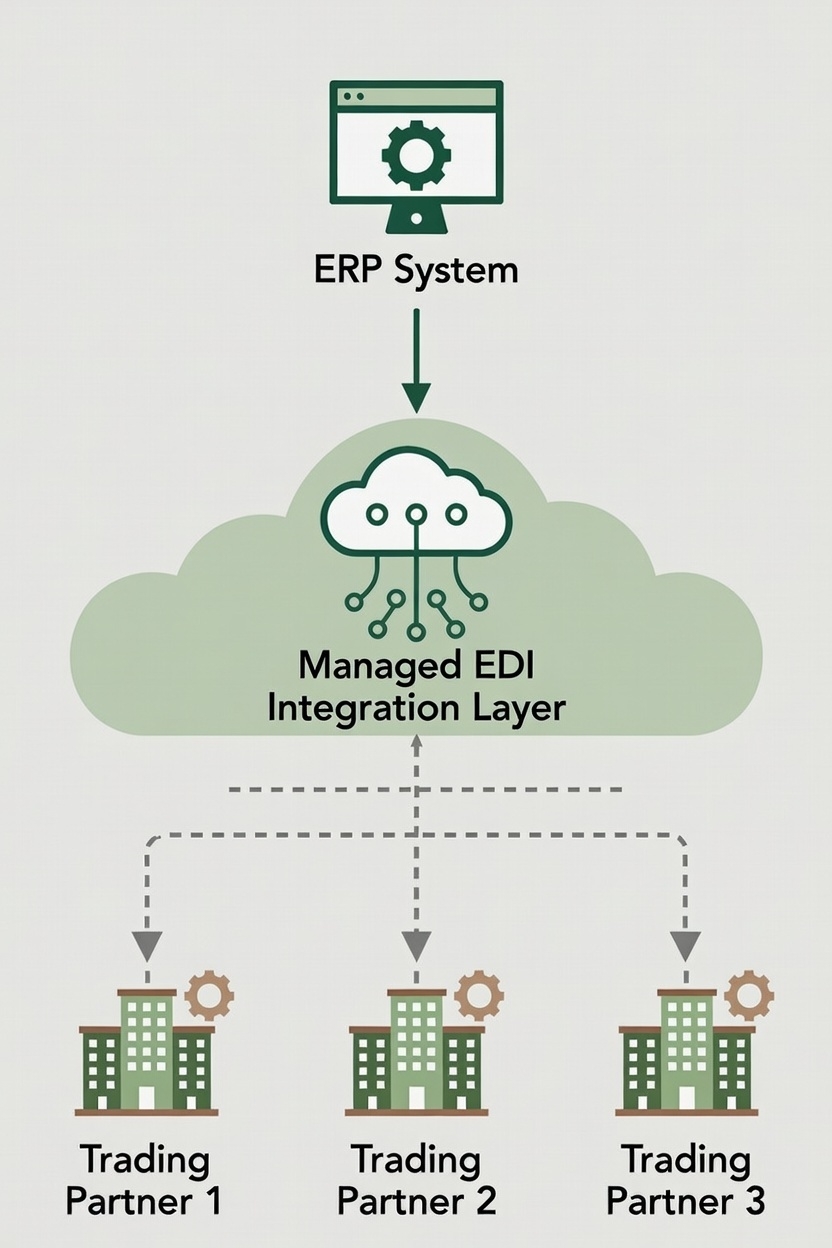
    EDI integration layer between ERP systems and trading partners

    The integration layer determines stability at scale.

    6) Use a Shortlist Decision Framework

    When comparing finalists, score each provider on:

    • Operational coverage
    • Partner onboarding maturity
    • Monitoring and SLAs
    • ERP integration capability
    • Commercial transparency
    • Security and compliance posture

    Conclusion

    Choosing an EDI outsourcing partner is about more than reducing IT workload. It’s about building a stable, scalable foundation for order-to-cash operations.

    For a deeper cost comparison, see our analysis of in-house vs outsourced EDI.

    Next step: Talk with our team to review your partner landscape and determine whether managed EDI is the right operating model for your organization.
  4. EDI Outsourcing Guide for Manufacturers & Distributors | Foundational

    Leave a Comment

    The Complete Guide to EDI Outsourcing for Mid-Market Manufacturers & Distributors

    For manufacturers and distributors, EDI isn’t optional—it’s how orders move, shipments get verified, and invoices get paid. But running EDI in-house often creates a quiet tax: stalled onboarding, mapping backlogs, fragile integrations, and exceptions that turn into chargebacks. This EDI outsourcing guide explains exactly what managed EDI is, how it works, what it costs, and how to select the right provider—so leadership can reduce risk while scaling partner connectivity.

    1) What “Managed EDI” Actually Means

    Managed EDI is outsourcing the day-to-day work of EDI operations—partner onboarding, mapping, testing, monitoring, exception handling, and standards maintenance—to a specialized team. Instead of your IT group living inside EDI tickets, you get predictable service levels and continuous monitoring.

    At a high level, a managed EDI partner provides:

    • Partner onboarding: certifications, requirements gathering, testing, go-live support
    • Mapping & translation: X12/EDIFACT transformations, partner-specific variants
    • ERP integration: automated flows into/out of your ERP and operational systems
    • 24/7 monitoring: proactive exception alerts before partners escalate issues
    • Security & compliance: encryption, audit trails, access controls, retention

    Business outcome: fewer errors, faster onboarding, predictable cost, and better visibility into transaction health.

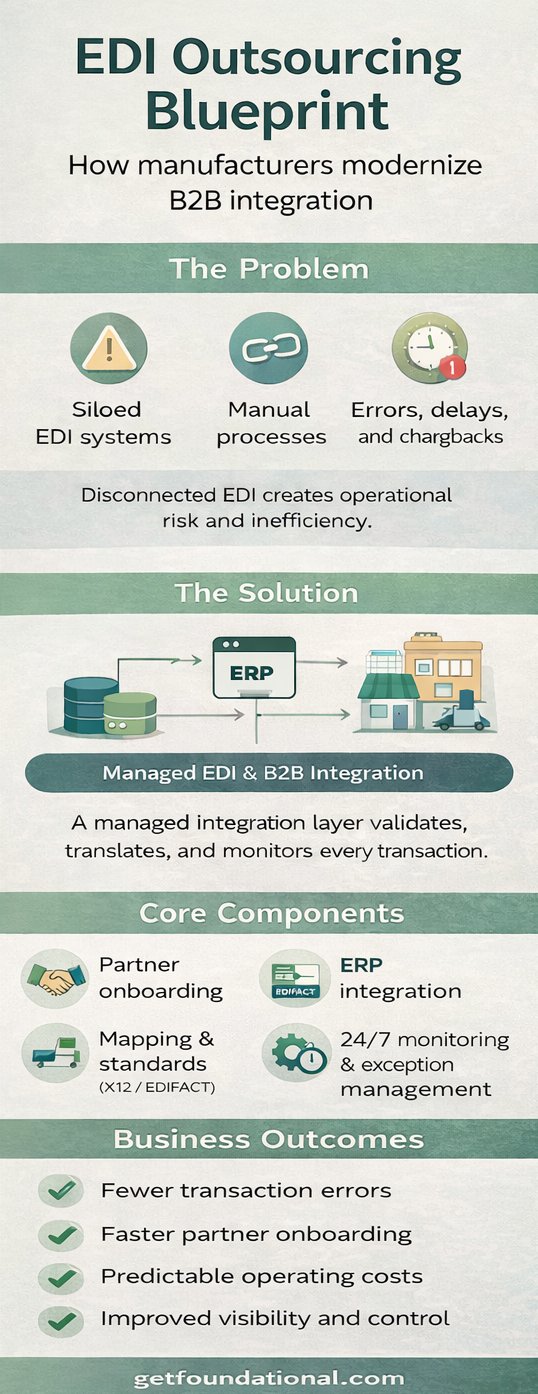
    EDI outsourcing blueprint showing how managed EDI integrates ERP systems with trading partners.

    Managed EDI as an operating model: integration + monitoring + scale.

    2) Signs You Should Outsource EDI

    • Onboarding is slow (new partners take weeks/months; sales or ops can’t move quickly).
    • Exceptions are constant (invoice mismatches, ASN issues, UOM errors, duplicate documents).
    • Key-person risk (one internal specialist holds tribal knowledge; vacations create downtime).
    • Chargebacks are rising (late ASNs, missing acknowledgements, non-compliant labels/docs).
    • IT is overloaded (EDI requests compete with ERP projects, analytics, security work).

    3) In-House vs Outsourced: Cost, Risk, and Time-to-Value

    In-house EDI looks controllable on paper until you account for staffing, coverage, and constant change across partners. Outsourcing converts EDI from a fragile internal function into an operating service with defined SLAs and scalable onboarding.

    Most mid-market organizations see ROI from:

    • Lower error volume: fewer disputes/chargebacks and less manual rework
    • Faster partner onboarding: revenue and service improvements land sooner
    • Reduced IT burden: internal teams shift to higher-leverage initiatives
    • Predictable budgeting: subscription + usage rather than surprise hires and fire drills
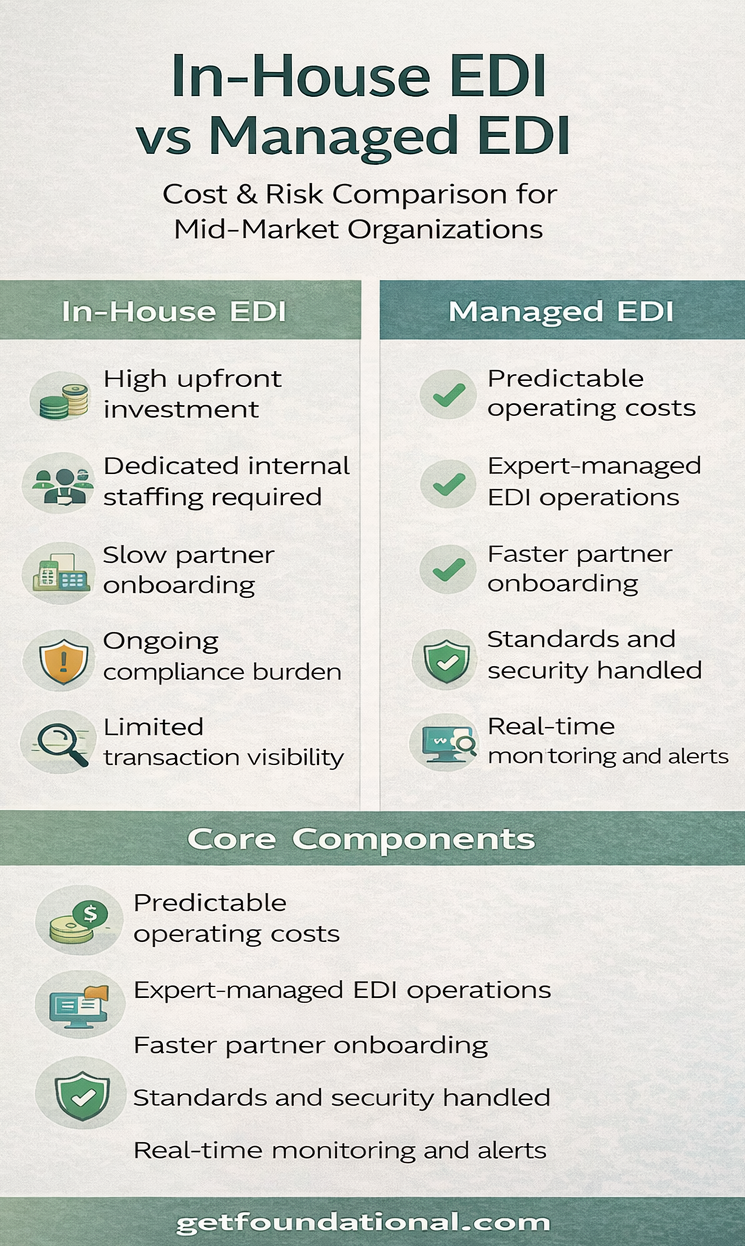
    Comparison of in-house EDI versus managed EDI across cost, staffing, compliance, and visibility.

    A practical executive comparison: cost model + operational risk.

    4) What You’re Really Buying When You Outsource

    Outsourcing isn’t “buying software.” You’re buying operational capability—a team, processes, tooling, and a reliability layer between your ERP and every trading partner. That includes standards expertise, monitoring and SLAs, change management, and scalable onboarding.

    5) Standards, Protocols, and Trading Partner Reality

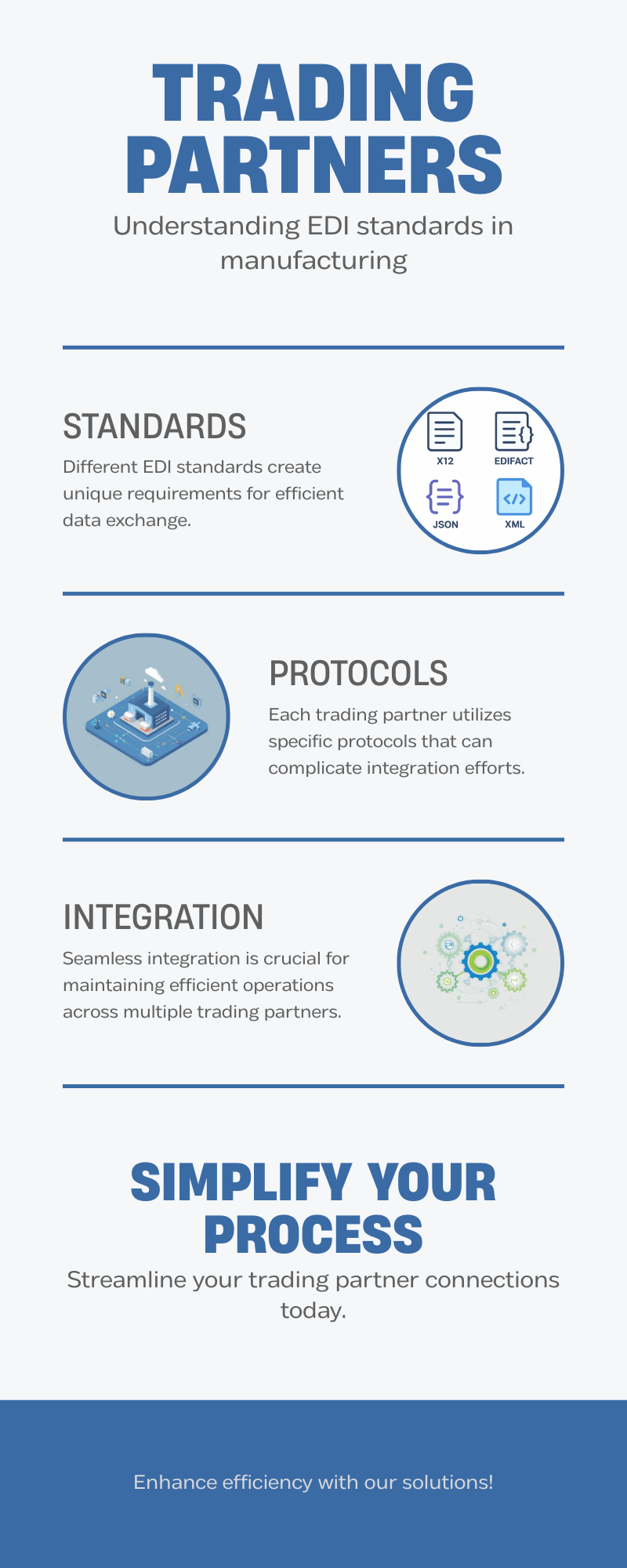
    In practice, “EDI compliance” is not just a standard. It’s standards plus partner-specific requirements. Managed providers typically support ANSI X12, EDIFACT, GS1 variants, and common protocols like AS2, SFTP, FTPS, and VAN connectivity.

    6) Security and Compliance: What to Require

    • Encryption in transit (and at rest where appropriate)
    • Role-based access controls and auditable change logs
    • Data retention policies aligned to your contracts and regulations
    • Monitoring and alerting for failures, delays, and anomalies

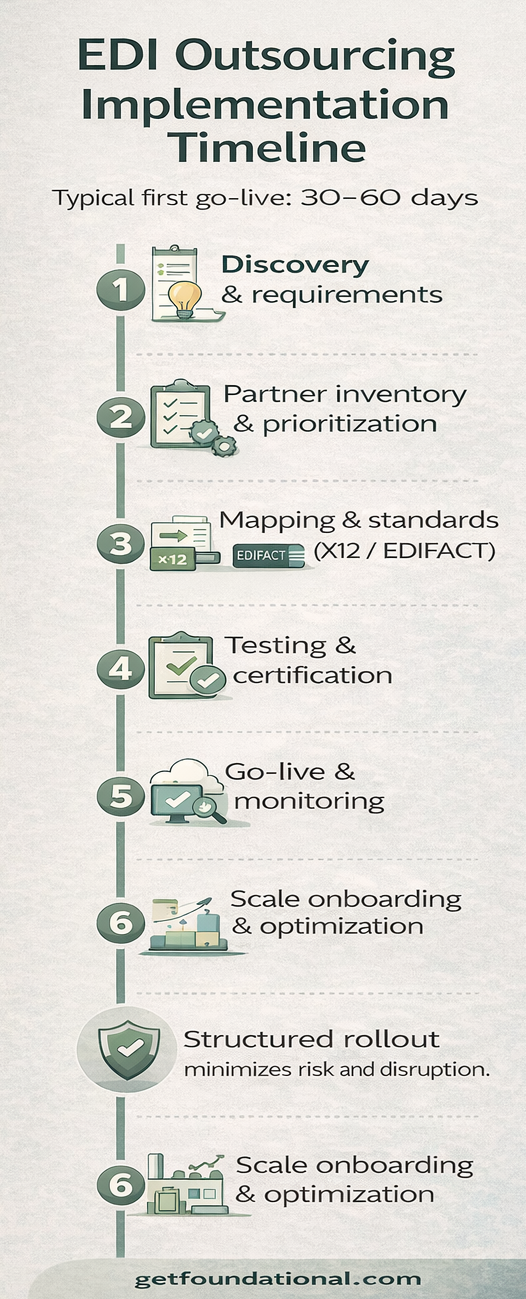
    7) Implementation Timeline: How Outsourcing Actually Rolls Out

    A practical rollout starts with high-value partners and core documents, then scales. The goal is a fast first go-live, then parallel onboarding so growth doesn’t bottleneck.

    • Discovery & requirements: define scope, docs, partner priorities
    • Partner inventory & prioritization: rank partners by volume and risk
    • Mapping & standards setup: baseline maps + partner variants
    • Testing & certification: partner testing windows and validations
    • Go-live & monitoring: stabilize flows and exception routing
    • Scale onboarding: add partners in parallel using repeatable playbooks

    Typical first-partner go-live: 30–60 days depending on partner testing cycles and ERP readiness.

    EDI outsourcing implementation timeline from discovery through partner onboarding and scale.

    A phased approach optimized for speed and stability.

    8) Provider Selection Checklist (Executive View)

    • Coverage: your key partners, documents, protocols, and standards
    • ERP integration ability: clean handoffs, validations, and exception routing
    • Onboarding process maturity: repeatable steps, clear timelines, stakeholder ownership
    • Monitoring & SLAs: alerting, resolution targets, escalation clarity
    • Change management: how partner changes and standards updates are handled
    • Security posture: access controls, audit trails, encryption, retention
    • Commercial model: transparent pricing and predictable scaling with volume

    Conclusion

    EDI is a revenue and service function disguised as an IT function. For mid-market manufacturers and distributors, outsourcing EDI is often the fastest route to fewer errors, faster onboarding, and predictable costs—while freeing internal teams to focus on ERP, analytics, and growth initiatives.

    Next step: Contact us to evaluate your partner network, identify the fastest ROI path, and build an outsourcing rollout plan.

  5. How ERP-Integrated EDI Reduces Supply Chain Errors

    Leave a Comment

    When EDI runs in a silo from your ERP, errors sneak in—mismatched POs, duplicate invoices, missed ASNs, delayed payments. ERP-integrated EDI eliminates manual re-keying, syncs master data, and automates validations so your team spends less time chasing fixes and more time moving orders.

    What Is ERP-Integrated EDI?

    ERP-integrated EDI is a direct, automated connection between your ERP (items, pricing, partners, orders) and your EDI transaction flows. Instead of exporting/importing files or keying data by hand, records move bi-directionally in real time or near-real time. The result is fewer touchpoints, fewer errors, and faster cycles.

    • Single source of truth: Items, units, and partner IDs align to ERP master data.
    • Automatic mapping: Transformations to GS1 / ANSI X12 occur behind the scenes.
    • Closed-loop updates: Status, acknowledgements, and exceptions flow back into the ERP.
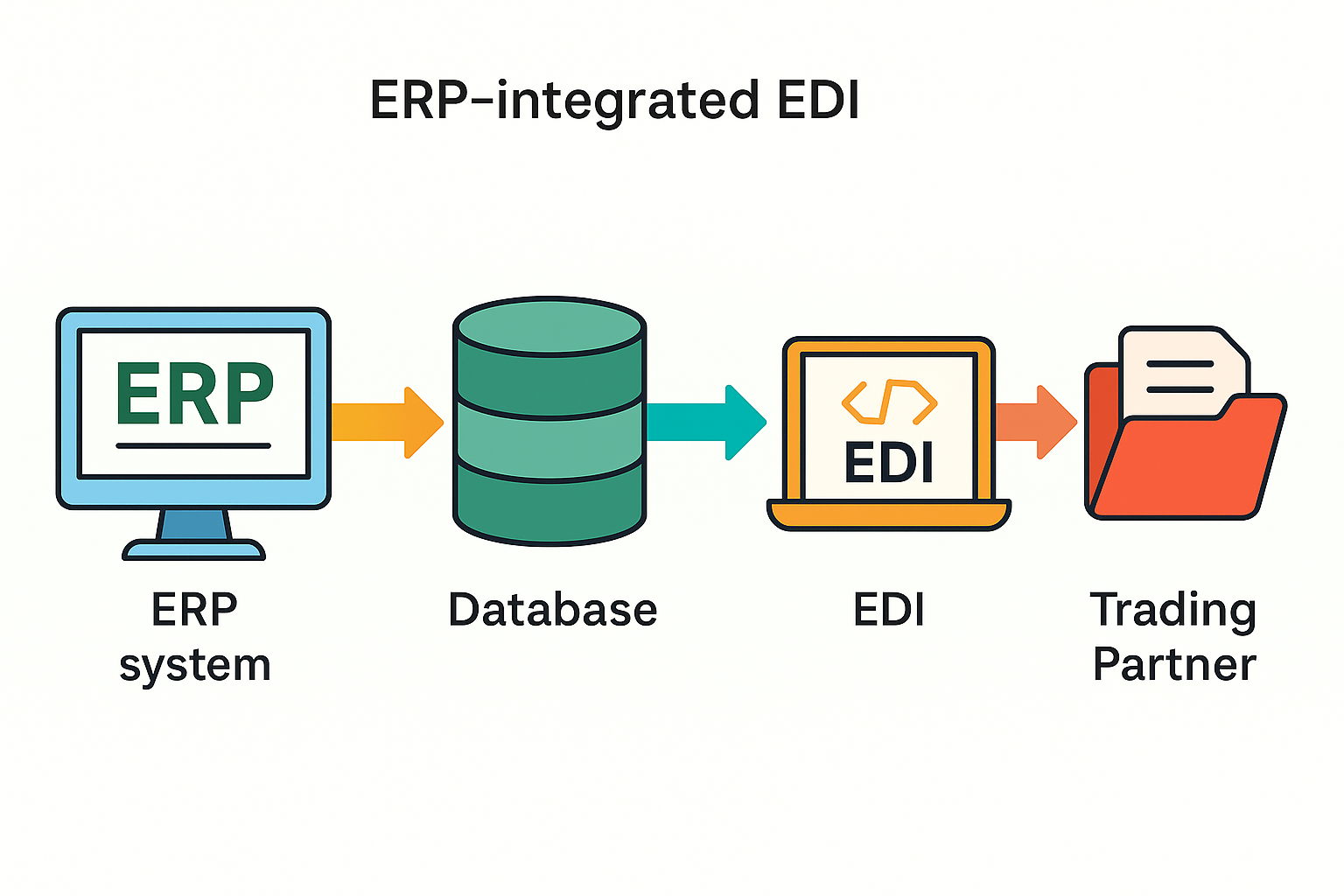
    ERP integrated EDI data flow from ERP to EDI to trading partners.

    From ERP to EDI to trading partners—fully connected flows.

    How Integration Reduces Errors

    Most supply-chain mistakes trace back to manual entry and mismatched data. Integration prevents these issues at the source:

    • PO ↔ Invoice agreement: Quantities, prices, and units are validated automatically.
    • Catalog integrity: Item codes, pack sizes, GTINs, and UOMs inherit from ERP masters.
    • Partner-specific rules: Retailer mandates are enforced before transmission.

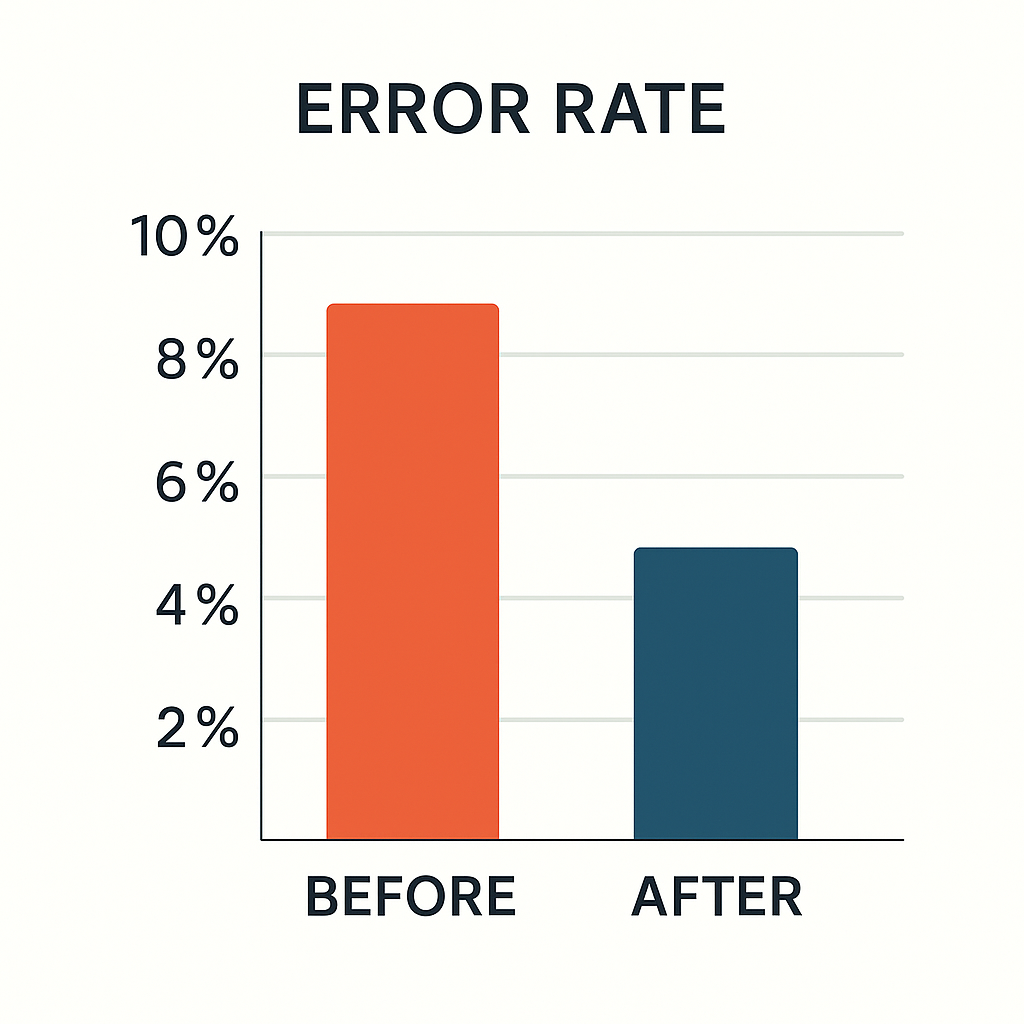
    Why it matters: Fewer exceptions and chargebacks, faster dispute resolution, and measurably lower error rates across the order-to-cash cycle.

    Error rate before ERP-integrated EDI versus after implementation.

    Typical error rate drops after ERP-integrated EDI implementation.

    Documents That Benefit Most

    Automation delivers outsized impact on high-volume, high-touch documents. With ERP-integrated EDI, these flow cleanly without re-keying:

    • 850 Purchase Orders → validated to item/pricing master data
    • 855/997 Acks → confirmation and audit trail back to ERP
    • 856 Advanced Ship Notices → packing detail validated to orders
    • 810 Invoices → price/qty checks minimize disputes
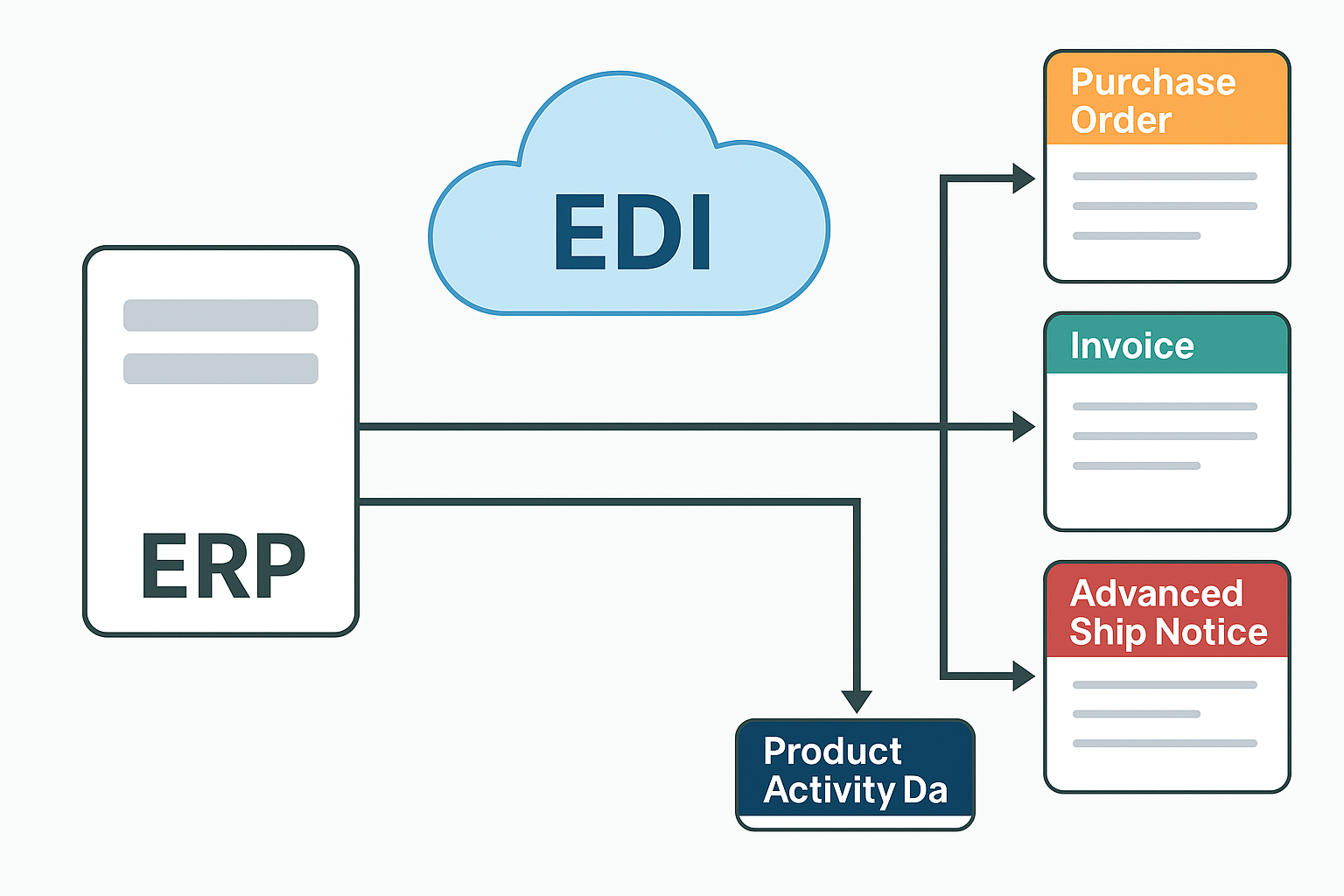
    • 852 Product Activity → demand and inventory signals integrated to planning
    ERP to EDI integration across purchase orders, invoices, ASNs, and product activity.

    Which documents gain the most from integration.

    Compliance, Security & Visibility

    Integrated EDI keeps you aligned to GS1/X12, enforces partner-specific rules, and routes acknowledgements for audit. Add 24/7 monitoring and real-time exception alerts, and your team sees issues before partners do—shrinking cycle times and protecting OTIF performance.

    • Standards: GS1 / ANSI X12 consistency reduces mapping friction.
    • Security: Encrypted transport, role-based access, and audit trails.
    • Visibility: Exceptions push back into ERP queues for rapid resolution.

    Implementation Pattern & Timeline

    Most mid-market teams roll out in phases: start with PO/ASN/Invoice for top partners, then expand. A typical pattern: discovery & mapping (2–4 weeks), pilot connections (2–6 weeks), scale out (ongoing). With a managed provider, onboarding runs in parallel so growth doesn’t stall on hiring.

    Conclusion

    ERP-integrated EDI removes the root causes of supply-chain errors—manual entry and data mismatch—while improving compliance and speed. If you’re ready to shrink exceptions, reduce chargebacks, and accelerate partner onboarding, integrating EDI to ERP is the most reliable path forward.

    Next step: Talk with our team about an integration plan tailored to your ERP and trading partners.

  6. In-House vs Outsourced EDI: Which Is Right for Your Business?

    Leave a Comment

    For many manufacturers and distributors, deciding between in-house EDI and outsourced EDI services is a strategic choice that impacts cost, speed, compliance, and scalability. The wrong model can inflate spend, increase chargebacks, and slow onboarding. The right model reduces errors, accelerates growth, and frees up IT. This guide compares both approaches so you can make a confident decision.

    What Is In-House EDI?

    In-house EDI means your team licenses and runs EDI software, builds and maintains maps, onboards trading partners, monitors transactions, and handles support. You get full control and deep customization, but you also absorb staffing, infrastructure, and ongoing maintenance.

    • Pros: Control, direct access to systems, tailored customizations.
    • Cons: High upfront/ongoing costs, staff dependency, slower partner onboarding, upkeep of standards compliance.
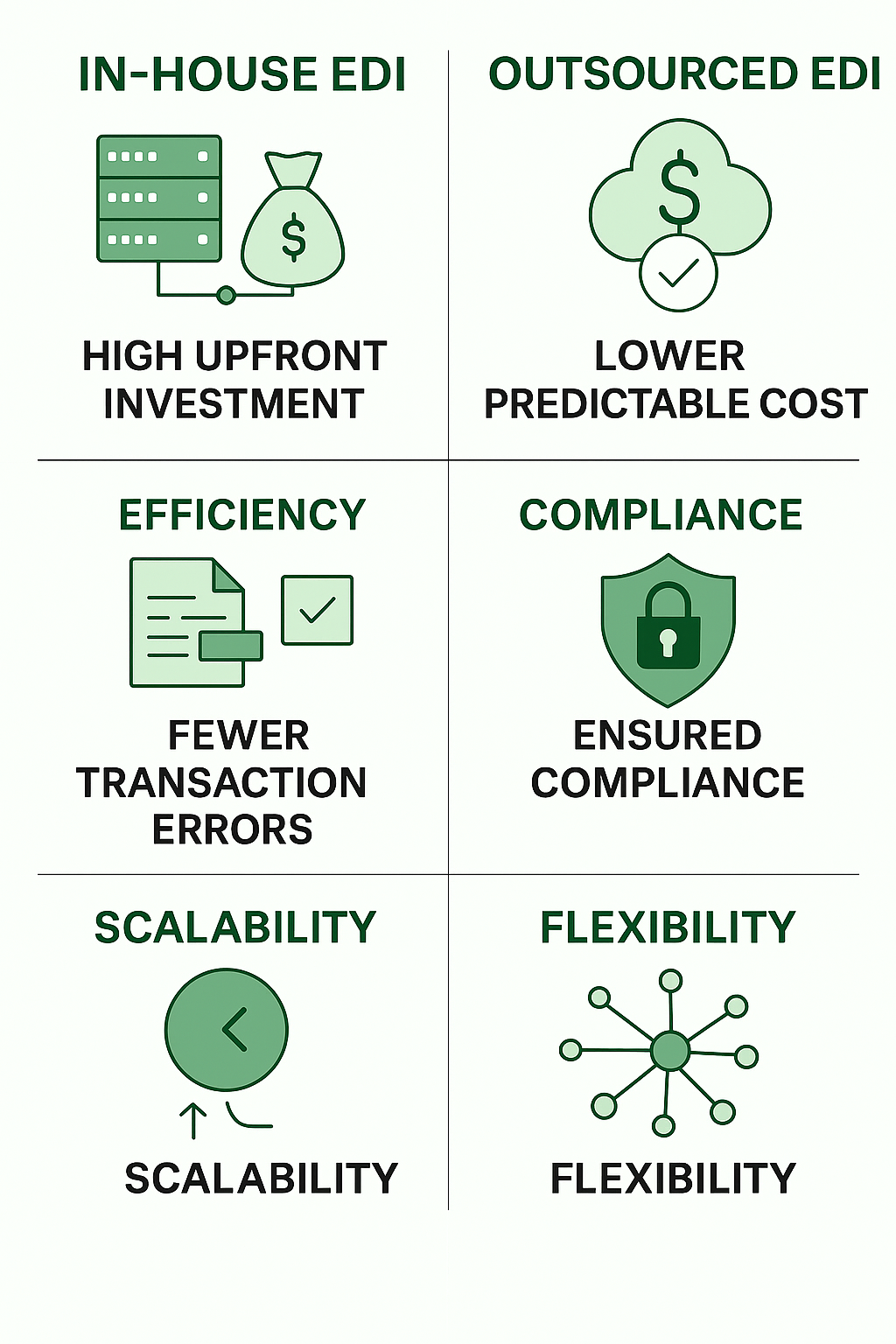
    In-house vs outsourced EDI cost and efficiency comparison.

    In-house vs outsourced EDI—key trade-offs at a glance.

    What Is Outsourced (Managed) EDI?

    Outsourced or managed EDI services shift the workload to a specialist that handles mapping, testing, onboarding, monitoring, error handling, SLAs, and compliance updates—all as a service. This turns EDI into a predictable operating expense with expert support.

    • Pros: Predictable costs, 24/7 monitoring, faster onboarding, standards expertise (GS1, ANSI X12), reduced internal burden.
    • Cons: Vendor reliance, subscription fees.
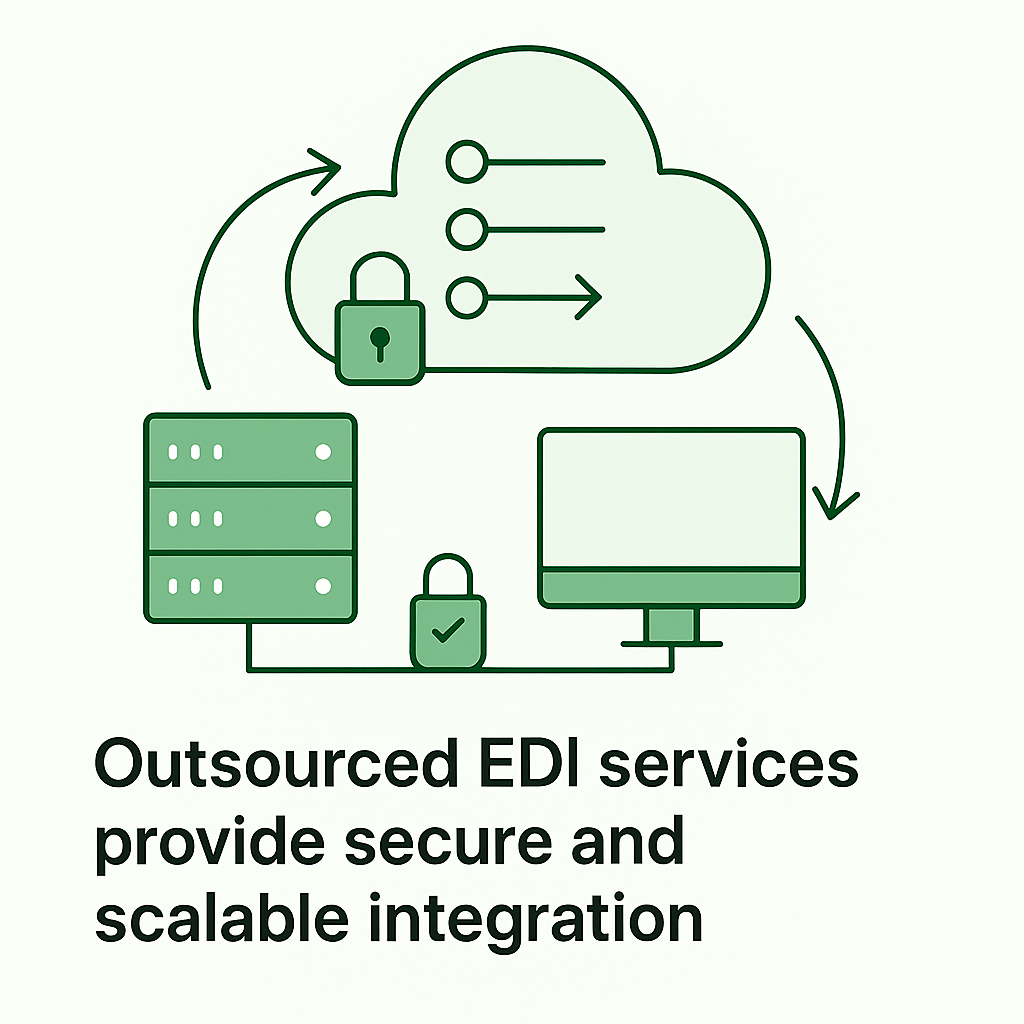
    Outsourced EDI services provide secure and scalable integration.

    Secure, scalable EDI integration via a managed cloud workflow.

    Cost Comparison: In-House vs Outsourced EDI

    In-house EDI typically requires software licenses, servers/cloud, and specialized staff—plus time to build and maintain maps. Managed EDI replaces capex with opex, consolidates tooling, and reduces error-related costs. Many mid-market organizations realize 20–30% total cost savings versus in-house management.

    Industry insight: Statista reports supply-chain inefficiencies can cost 9–20% of annual revenue. Automating data exchange through managed EDI reduces transaction errors (often up to 35%) and prevents costly delays and chargebacks.

    Efficiency, Compliance & Security

    In-house teams juggle mapping changes, partner requirements, and evolving standards—work that compounds as your network grows. Managed EDI centralizes this, applying best practices across partners and formats, while proactively monitoring transactions around the clock.

    • Standards & interoperability: Align to GS1 and ANSI X12 to reduce mapping friction and compliance risk.
    • Security: Enterprise-grade encryption and auditing improve resilience versus ad-hoc internal setups.
    • Speed: Automation removes manual keying and error chasing, accelerating order-to-cash and procure-to-pay cycles.
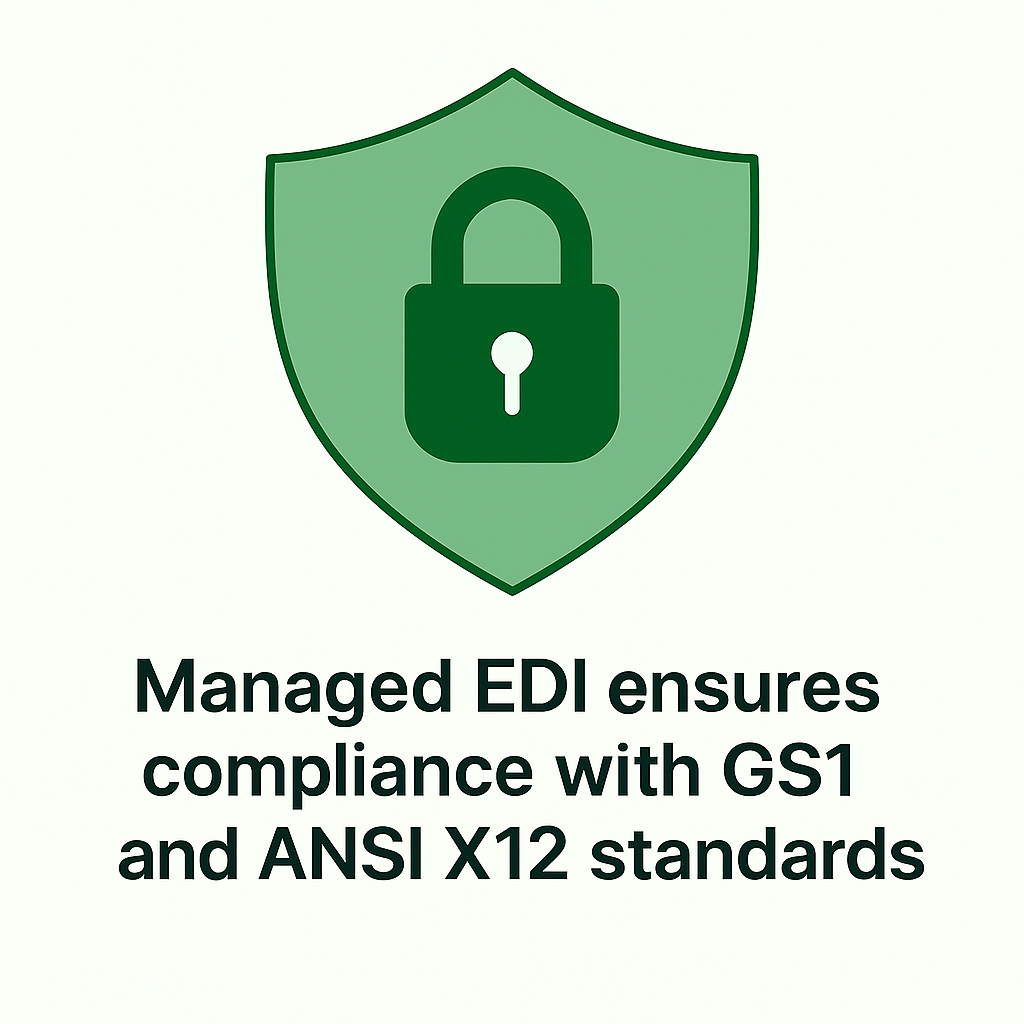
    Managed EDI ensures compliance with GS1 and ANSI X12 standards.

    Built-in adherence to GS1 and ANSI X12 standards.

    Scalability & Time-to-Value

    Each new partner adds maps, tests, certificates, and support. In-house teams are limited by available staff hours. Managed EDI providers scale onboarding across protocols (AS2, SFTP, VAN) and trading requirements, so growth doesn’t stall while you hire and train.

    Outsourced EDI scales quickly to new trading partners and protocols.

    Scale to new partners and protocols without added IT burden.

    When In-House May Still Make Sense

    • Very large enterprises with established EDI teams and 24/7 coverage.
    • Highly specialized integrations where unique internal workflows matter more than speed.
    • Strict data residency mandates that your organization prefers to control directly.

    Decision Framework: Pick Your Best-Fit Model

    Criteria In-House EDI Outsourced (Managed) EDI
    Cost model Capex + staffing Predictable opex
    Onboarding speed Team-limited Provider-scaled
    Compliance & updates DIY standards upkeep Provider maintains GS1/X12
    Monitoring & uptime Internal coverage 24/7 monitoring with SLAs
    Scalability Staff-constrained Elastic growth

    Conclusion

    The debate of EDI outsourcing vs in-house comes down to cost, speed, risk, and scale. For most mid-market manufacturers and distributors, managed EDI delivers faster ROI, fewer errors, and simpler growth—without expanding internal headcount.

    Next step: Contact us to review your current EDI model and quantify the savings from outsourcing.

  7. Why Manufacturers Choose Managed EDI Services for Reliable B2B Integration

    Leave a Comment

    In today’s fast-paced supply chain landscape, the phrase managed EDI services is no longer just jargon—it’s a strategic lifeline for manufacturers and distributors. If your company is looking to streamline B2B document exchange while cutting costs and eliminating IT headaches, this article shows why outsourcing your EDI to experts is the smarter, more scalable choice.

    What Are Managed EDI Services?

    Managed EDI services involve outsourcing all aspects of electronic data interchange to a specialized provider—from setup, mapping, and trading partner onboarding to ERP integration, monitoring, and daily operations. Unlike basic outsourcing that merely hosts your EDI system, a managed service fully operates it on your behalf with proactive support and SLAs. Learn more about EDI standards from GS1.

    Cost Savings & Efficiency Gains for Manufacturers

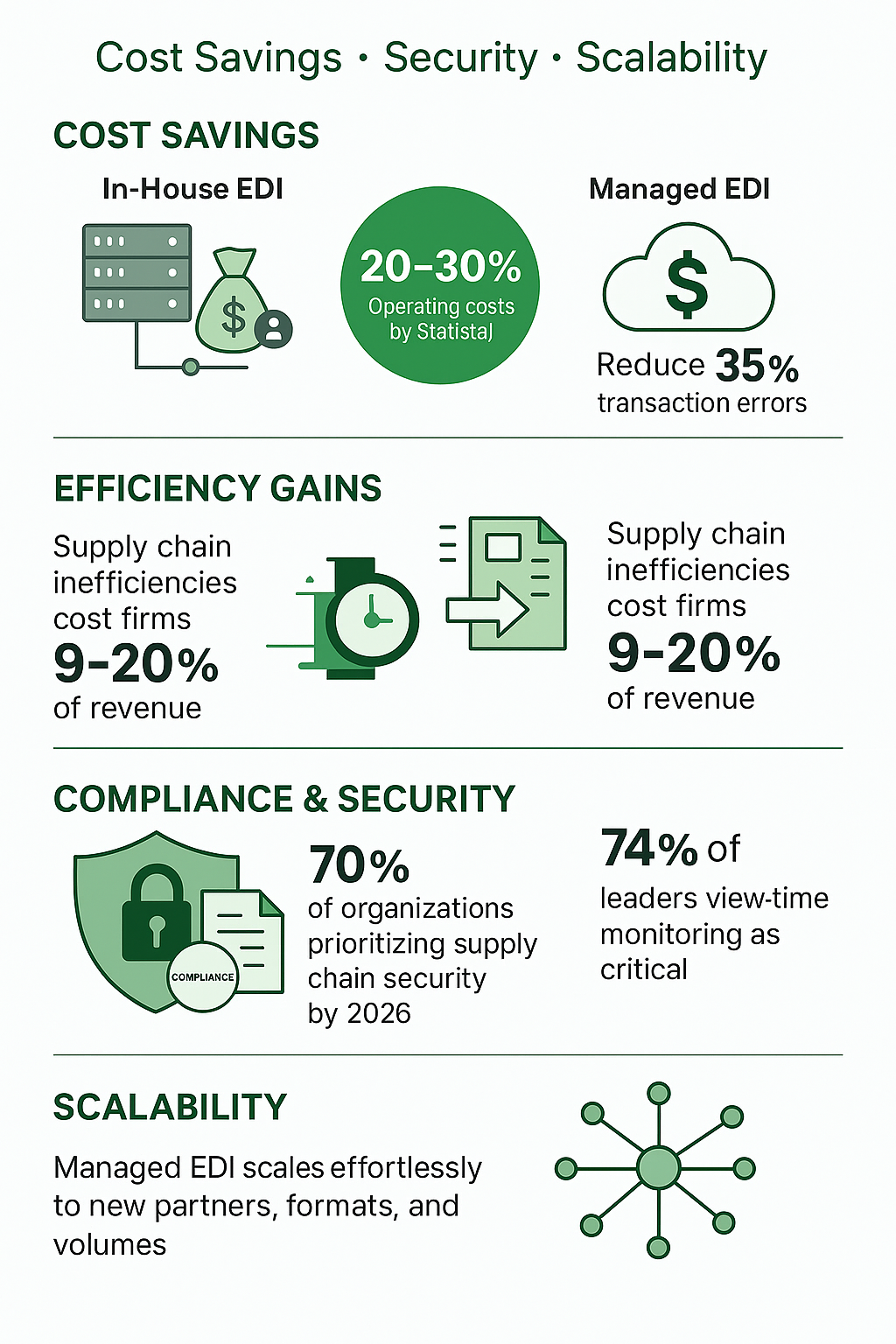
    One of the strongest arguments for outsourcing EDI is cost reduction. Maintaining in-house EDI—including software licenses, hardware, and specialized staffing—can absorb a significant share of IT budgets. Outsourcing converts this into predictable operating expense and typically eliminates 20–30% of associated costs while reducing error-prone manual work.

    Infographic: Cost Savings, Security, Scalability benefits of managed EDI services
    Why businesses choose managed EDI services.

    Industry data backs this up: According to a
    Statista overview, supply chain inefficiencies cost businesses an estimated 9–20% of annual revenue. By outsourcing EDI to a managed provider, companies can reduce transaction errors by up to 35% and cut operating costs by 20–30% compared to in-house management.

    Compliance, Security & 24/7 Reliability

    EDI touches sensitive transactional data, so secure transmission, standards compliance, and high availability are essential. Managed providers deliver enterprise-grade encryption, audit-ready infrastructure, continuous updates to standards, and round-the-clock monitoring—capabilities that are costly to replicate internally. For organizations in regulated industries, aligning with ANSI X12 standards supports interoperability and auditability.

    Security focus: Gartner notes that over 70% of organizations will prioritize investments in supply chain security and compliance technologies by 2026. A 2023 McKinsey study found that 45% of supply chain leaders view real-time monitoring as a critical capability to reduce risks and ensure compliance.

    Fast Onboarding & Scalability for Distribution Businesses

    Scaling trade relationships quickly is critical for distributors. A managed EDI provider streamlines onboarding, mapping, testing, and go-live across a variety of protocols (AS2, FTP, VAN) so you can add partners and meet retailer mandates without expanding internal IT headcount. See trend coverage at Supply Chain Brain.

    Choosing the Right Managed EDI Service Provider

    When evaluating providers, focus on:

    • Coverage: Communication protocols, EDI standards, and retailer/commercial partner requirements.
    • ERP integration: Breadth and depth of supported ERPs and iPaaS connectors.
    • Operational model: Proactive monitoring, error handling, and clear SLAs.
    • Security & compliance: Certifications, encryption, data retention, and audit support.
    • Pricing transparency: Clear fees for onboarding, maps, kilocharacter usage, and support tiers.

    The U.S. SBA technology adoption guide offers a helpful framework for evaluating managed IT solutions.

    Conclusion

    By embracing managed EDI services, manufacturers and distributors can convert complex, costly EDI operations into a streamlined service with predictable costs, stronger security, and faster partner onboarding. If you’re ready to eliminate the burden of in-house EDI and accelerate trading partner connections, our Managed EDI & B2B Services deliver proven, business-focused results.

    Call to Action: Contact us today to discover how our managed EDI solutions can save time, reduce operational costs, and scale securely with your business.