EDI Outsourcing Guide for Manufacturers & Distributors | Foundational
By Brian Eckenrod on
The Complete Guide to EDI Outsourcing for Mid-Market Manufacturers & Distributors
For manufacturers and distributors, EDI isn’t optional—it’s how orders move, shipments get verified, and invoices get paid. But running EDI in-house often creates a quiet tax: stalled onboarding, mapping backlogs, fragile integrations, and exceptions that turn into chargebacks. This EDI outsourcing guide explains exactly what managed EDI is, how it works, what it costs, and how to select the right provider—so leadership can reduce risk while scaling partner connectivity.
1) What “Managed EDI” Actually Means
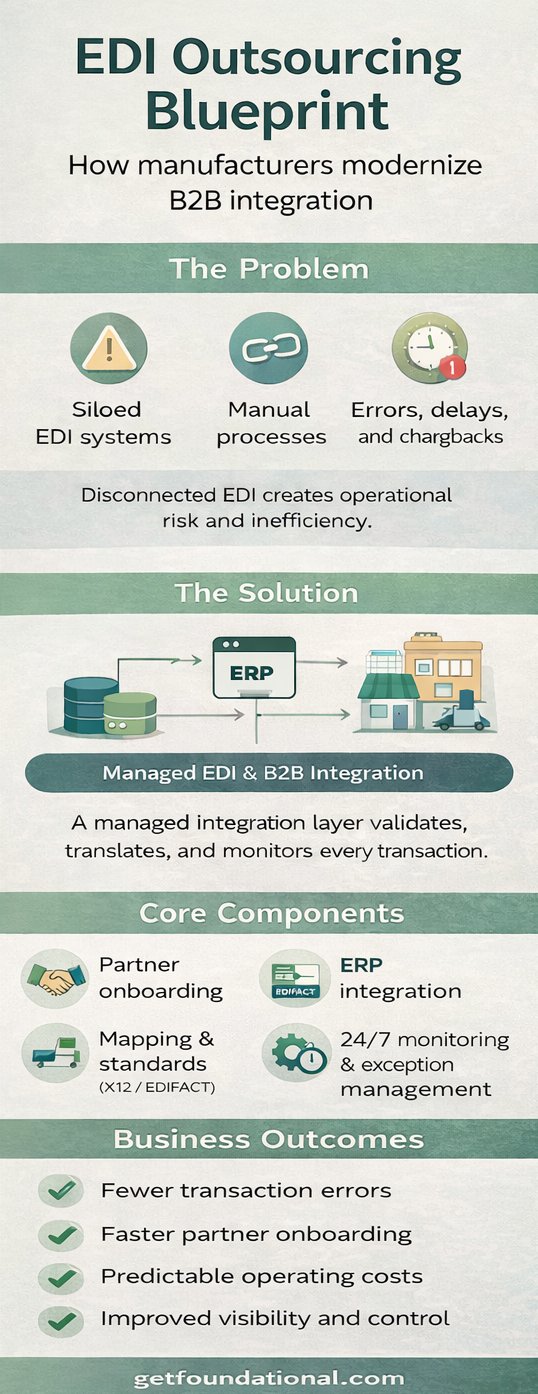
Managed EDI is outsourcing the day-to-day work of EDI operations—partner onboarding, mapping, testing, monitoring, exception handling, and standards maintenance—to a specialized team. Instead of your IT group living inside EDI tickets, you get predictable service levels and continuous monitoring.
At a high level, a managed EDI partner provides:
- Partner onboarding: certifications, requirements gathering, testing, go-live support
- Mapping & translation: X12/EDIFACT transformations, partner-specific variants
- ERP integration: automated flows into/out of your ERP and operational systems
- 24/7 monitoring: proactive exception alerts before partners escalate issues
- Security & compliance: encryption, audit trails, access controls, retention
Business outcome: fewer errors, faster onboarding, predictable cost, and better visibility into transaction health.
2) Signs You Should Outsource EDI
- Onboarding is slow (new partners take weeks/months; sales or ops can’t move quickly).
- Exceptions are constant (invoice mismatches, ASN issues, UOM errors, duplicate documents).
- Key-person risk (one internal specialist holds tribal knowledge; vacations create downtime).
- Chargebacks are rising (late ASNs, missing acknowledgements, non-compliant labels/docs).
- IT is overloaded (EDI requests compete with ERP projects, analytics, security work).
3) In-House vs Outsourced: Cost, Risk, and Time-to-Value
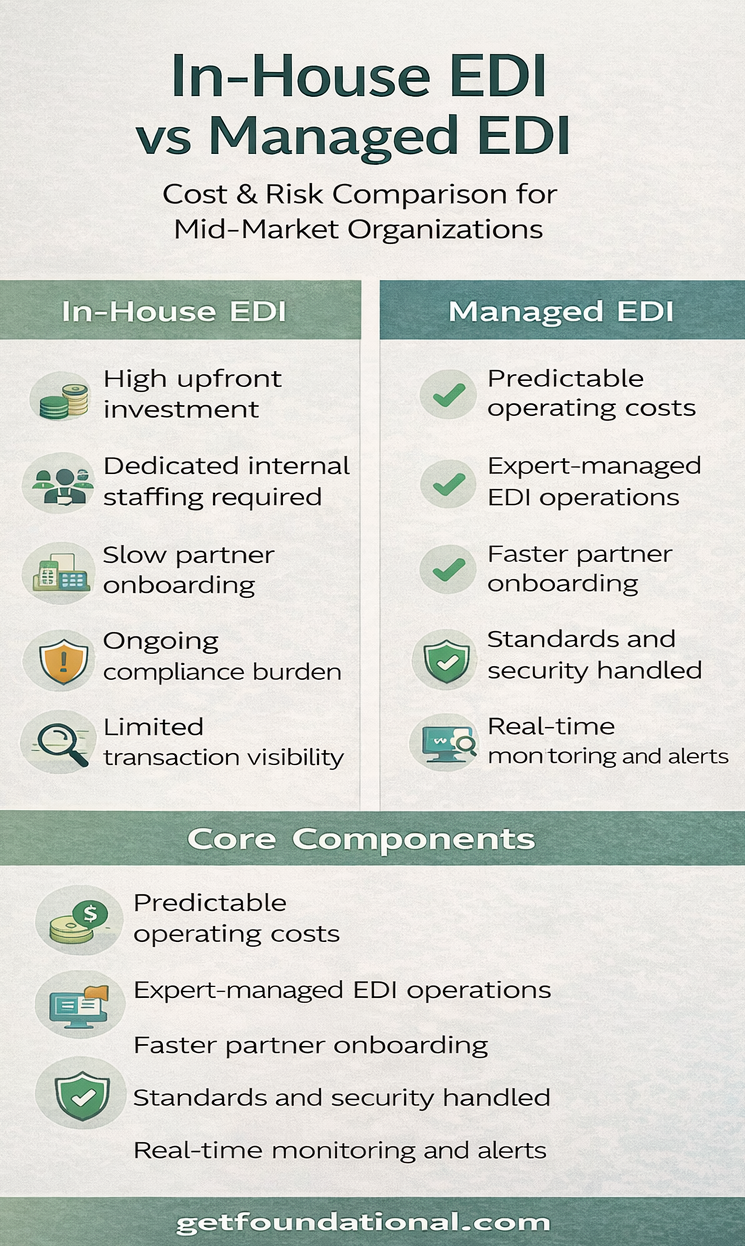
In-house EDI looks controllable on paper until you account for staffing, coverage, and constant change across partners. Outsourcing converts EDI from a fragile internal function into an operating service with defined SLAs and scalable onboarding.
Most mid-market organizations see ROI from:
- Lower error volume: fewer disputes/chargebacks and less manual rework
- Faster partner onboarding: revenue and service improvements land sooner
- Reduced IT burden: internal teams shift to higher-leverage initiatives
- Predictable budgeting: subscription + usage rather than surprise hires and fire drills
4) What You’re Really Buying When You Outsource
Outsourcing isn’t “buying software.” You’re buying operational capability—a team, processes, tooling, and a reliability layer between your ERP and every trading partner. That includes standards expertise, monitoring and SLAs, change management, and scalable onboarding.
5) Standards, Protocols, and Trading Partner Reality
In practice, “EDI compliance” is not just a standard. It’s standards plus partner-specific requirements. Managed providers typically support ANSI X12, EDIFACT, GS1 variants, and common protocols like AS2, SFTP, FTPS, and VAN connectivity.
6) Security and Compliance: What to Require
- Encryption in transit (and at rest where appropriate)
- Role-based access controls and auditable change logs
- Data retention policies aligned to your contracts and regulations
- Monitoring and alerting for failures, delays, and anomalies
7) Implementation Timeline: How Outsourcing Actually Rolls Out
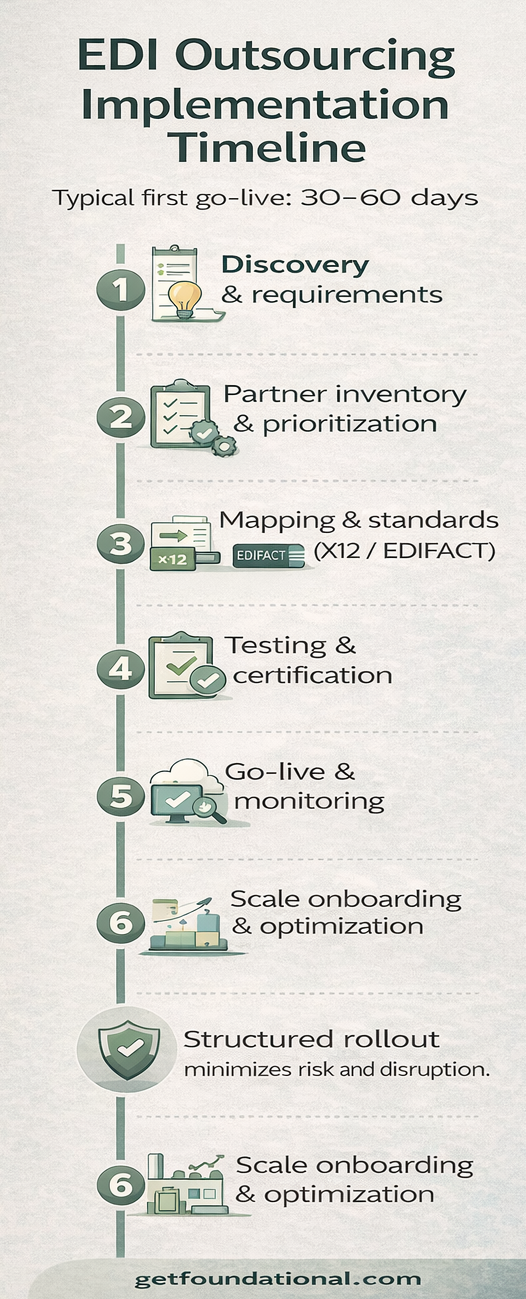
A practical rollout starts with high-value partners and core documents, then scales. The goal is a fast first go-live, then parallel onboarding so growth doesn’t bottleneck.
- Discovery & requirements: define scope, docs, partner priorities
- Partner inventory & prioritization: rank partners by volume and risk
- Mapping & standards setup: baseline maps + partner variants
- Testing & certification: partner testing windows and validations
- Go-live & monitoring: stabilize flows and exception routing
- Scale onboarding: add partners in parallel using repeatable playbooks
Typical first-partner go-live: 30–60 days depending on partner testing cycles and ERP readiness.
8) Provider Selection Checklist (Executive View)
- Coverage: your key partners, documents, protocols, and standards
- ERP integration ability: clean handoffs, validations, and exception routing
- Onboarding process maturity: repeatable steps, clear timelines, stakeholder ownership
- Monitoring & SLAs: alerting, resolution targets, escalation clarity
- Change management: how partner changes and standards updates are handled
- Security posture: access controls, audit trails, encryption, retention
- Commercial model: transparent pricing and predictable scaling with volume
Conclusion
EDI is a revenue and service function disguised as an IT function. For mid-market manufacturers and distributors, outsourcing EDI is often the fastest route to fewer errors, faster onboarding, and predictable costs—while freeing internal teams to focus on ERP, analytics, and growth initiatives.
Next step: Contact us to evaluate your partner network, identify the fastest ROI path, and build an outsourcing rollout plan.
Comments are closed