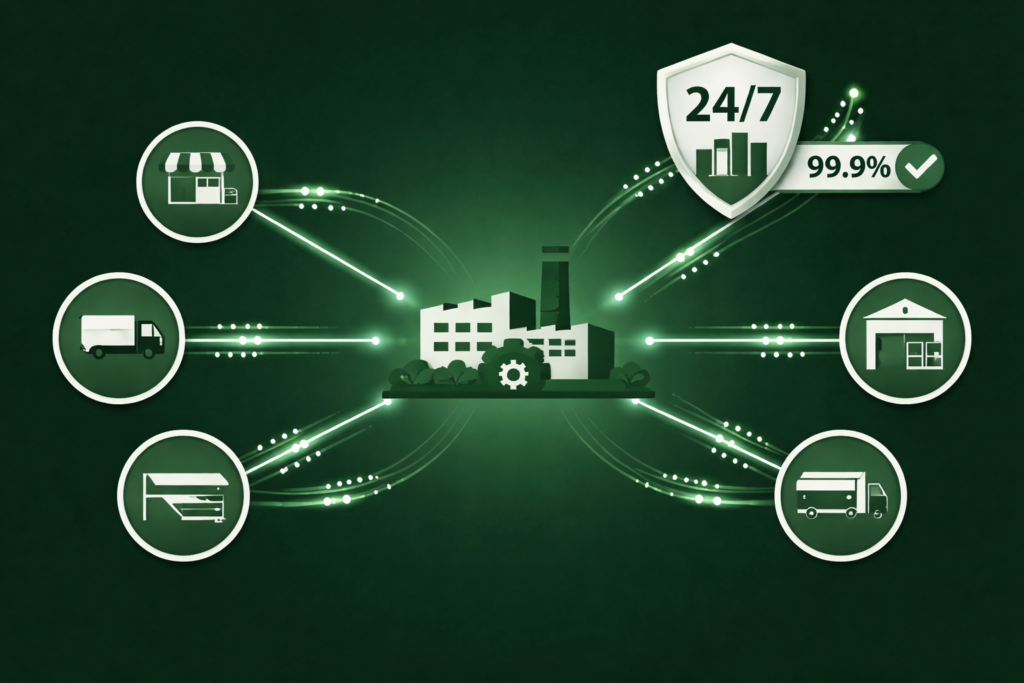
For manufacturers and distributors managing complex trading partner networks, managed EDI services have become a standard operating model — not because in-house EDI is impossible, but because the operational overhead of doing it well consistently exceeds what most internal teams can sustain.
Here’s why the shift to managed EDI keeps accelerating, and what it actually delivers.
What Managed EDI Services Include
Managed EDI services mean outsourcing all aspects of EDI operations to a specialized provider — setup, mapping, trading partner onboarding, ERP integration, monitoring, and daily operations. Unlike basic hosting, a fully managed service operates EDI on your behalf with proactive support, defined SLAs, and continuous monitoring.
The scope typically covers:
- Trading partner onboarding and certification across all required protocols
- Mapping and translation for X12, EDIFACT, and partner-specific variants
- ERP integration with validation, exception routing, and upgrade support
- 24/7 transaction monitoring with proactive exception alerts
- Standards maintenance as GS1, X12, and partner requirements change
The Cost Case for Outsourcing
Maintaining in-house EDI — software licenses, infrastructure, and specialized staffing — absorbs a disproportionate share of IT budgets relative to the business value delivered. Outsourcing converts that into a predictable operating expense and typically eliminates the most expensive components: dedicated headcount, coverage gaps, and the compounding cost of exceptions and chargebacks.
Most mid-market manufacturers and distributors see 20–30% total cost reduction compared to in-house management, plus additional savings from reduced error rates and faster onboarding cycles. Use our ROI Calculator to model the comparison for your specific situation.
Compliance, Security, and Reliability
EDI touches sensitive transactional data, making secure transmission, standards compliance, and high availability non-negotiable. Managed providers deliver enterprise-grade encryption, audit-ready infrastructure, continuous standards updates, and round-the-clock monitoring — capabilities that are expensive and difficult to replicate internally.
For organizations in regulated industries or with demanding retail trading partners, aligning with ANSI X12 standards and maintaining consistent compliance documentation is a requirement, not an option. A managed provider handles this continuously, not just at implementation time.
Faster Onboarding and Scalable Growth
Every new trading partner adds maps, tests, certifications, and support requirements. Internal teams are constrained by available hours. A managed EDI provider scales onboarding across protocols — AS2, SFTP, VAN — and handles partner-specific requirements in parallel, so growth doesn’t stall while you hire and train.
This is especially important for manufacturers and distributors winning new retail accounts or expanding into new channels, where onboarding speed directly affects revenue timing.
What to Look for in a Provider
When evaluating managed EDI services, focus on:
- Coverage: communication protocols, EDI standards, and your specific trading partner requirements
- ERP integration: depth of supported ERPs and quality of the integration layer
- Operational model: proactive monitoring, clear SLAs, and defined exception handling
- Security and compliance: certifications, encryption standards, data retention, and audit support
- Pricing transparency: clear fees for onboarding, maps, usage, and support — no surprises as you scale
For a deeper evaluation framework, see our buyer’s guide to choosing an EDI outsourcing partner.
The Bottom Line
Managed EDI services convert complex, costly EDI operations into a streamlined service with predictable costs, stronger security, and faster partner onboarding. For manufacturers and distributors focused on growth, it removes a fragile operational dependency from the internal IT roadmap.
Contact us to learn how Foundational’s managed EDI and B2B integration services can reduce costs and scale with your business.
Ready to simplify your EDI operations?
Talk to a specialist about your trading partners, ERP, and current EDI setup. Talk to a Specialist