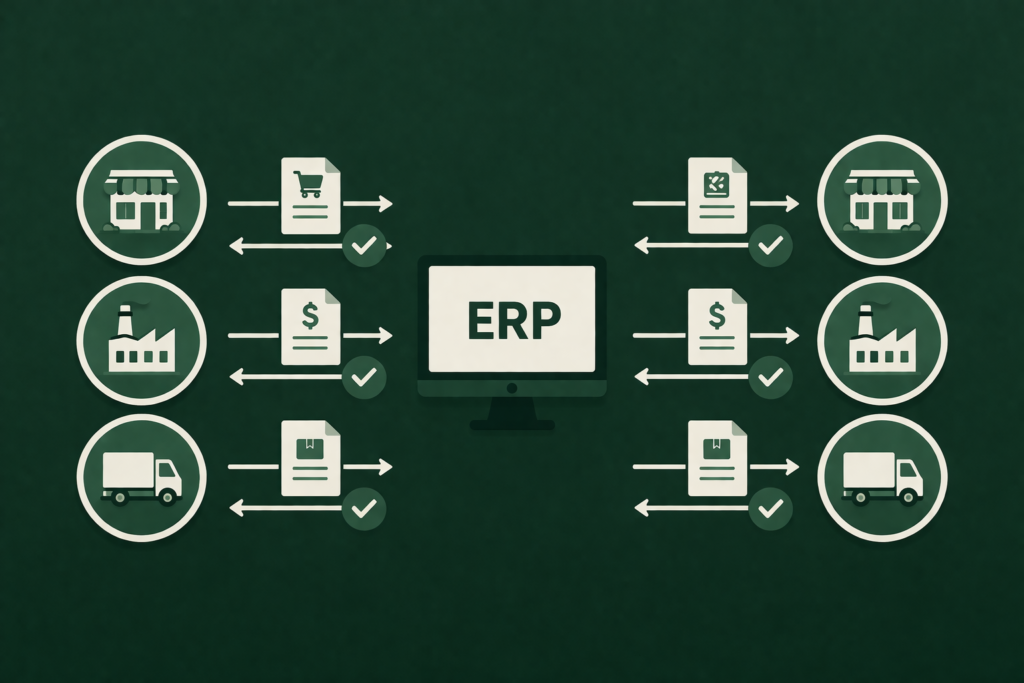
When EDI runs in a silo from your ERP, errors creep in from every direction — mismatched purchase orders, duplicate invoices, missed ASNs, delayed payments. ERP-integrated EDI eliminates manual re-keying, syncs master data, and automates validations so your team spends less time chasing exceptions and more time moving orders.
What ERP-Integrated EDI Actually Means
ERP-integrated EDI is a direct, automated connection between your ERP — items, pricing, trading partners, open orders — and your EDI transaction flows. Instead of exporting and importing files or keying data by hand, records move bi-directionally in real time or near-real time.
The result is fewer touchpoints, fewer errors, and faster order-to-cash cycles:
- Single source of truth: items, units, and partner IDs align directly to ERP master data
- Automatic mapping: transformations to GS1/ANSI X12 happen behind the scenes
- Closed-loop updates: status, acknowledgements, and exceptions flow back into the ERP automatically
How Integration Reduces Errors at the Source
Most supply chain mistakes trace back to manual entry and mismatched data — problems that integration prevents before they happen:
- PO/Invoice agreement: quantities, prices, and units are validated automatically against ERP records
- Catalog integrity: item codes, pack sizes, GTINs, and UOMs inherit from ERP master data
- Partner-specific rules: retailer mandates and compliance requirements are enforced before transmission
The downstream impact is measurable: fewer exceptions and chargebacks, faster dispute resolution, and lower error rates across the entire order-to-cash cycle.
Documents That Benefit Most
Automation delivers outsized impact on high-volume, high-touch document types. With ERP-integrated EDI, these flow cleanly without re-keying or manual intervention:
- 850 Purchase Orders — validated to item and pricing master data
- 855/997 Acknowledgements — confirmation and audit trail back to ERP
- 856 Advance Ship Notices — packing detail validated to open orders
- 810 Invoices — price and quantity checks minimize disputes
- 852 Product Activity — demand and inventory signals integrated to planning
Compliance, Security, and Visibility
Integrated EDI keeps you aligned to GS1/X12 standards, enforces partner-specific rules, and routes acknowledgements for audit. With 24/7 monitoring and real-time exception alerts, your team sees issues before trading partners do — shrinking cycle times and protecting on-time, in-full (OTIF) performance.
- Standards: GS1/ANSI X12 consistency reduces mapping friction across partners
- Security: encrypted transport, role-based access controls, and full audit trails
- Visibility: exceptions pushed back into ERP queues for rapid resolution
Implementation Approach
Most mid-market teams roll out ERP-integrated EDI in phases: start with PO/ASN/Invoice for top-volume partners, then expand to additional partners and document types. A typical pattern runs discovery and mapping (two to four weeks), then pilot connections (two to six weeks), then ongoing scale-out.
With a managed provider, onboarding runs in parallel across multiple partners — so growth doesn’t stall on hiring or internal bandwidth. Foundational supports integration with SAP, Oracle, NetSuite, Microsoft Dynamics, Epicor, and others.
The Bottom Line
ERP-integrated EDI removes the root causes of supply chain errors — manual entry and data mismatch — while improving compliance, speed, and partner satisfaction. If you’re ready to reduce exceptions, shrink chargebacks, and accelerate partner onboarding, integrating EDI to your ERP is the most reliable path forward.
Talk to our team about an integration plan tailored to your ERP and trading partners.
Ready to simplify your EDI operations?
Talk to a specialist about your trading partners, ERP, and current EDI setup. Talk to a Specialist